
‘Trial No.8’
Cooroy Butter Factory Arts Centre
Photography by Warwick Gow
UN | BOUND
Trial No. 8 | Odessa Mahony-de Vries
Butter Factory Arts Centre (Kabi Kabi Country)
July 23 - August 29, 2021
By Ruby Donohoe
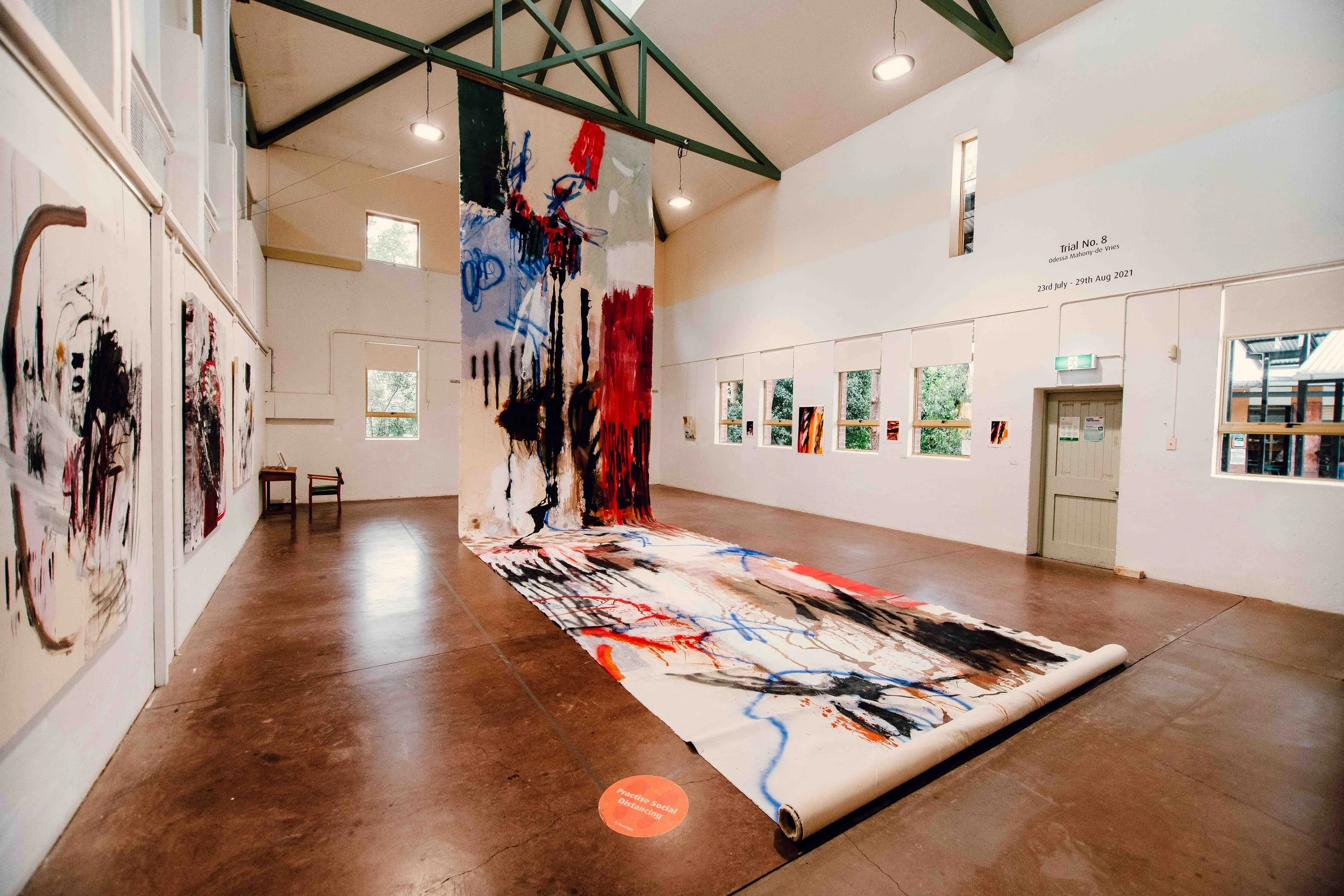
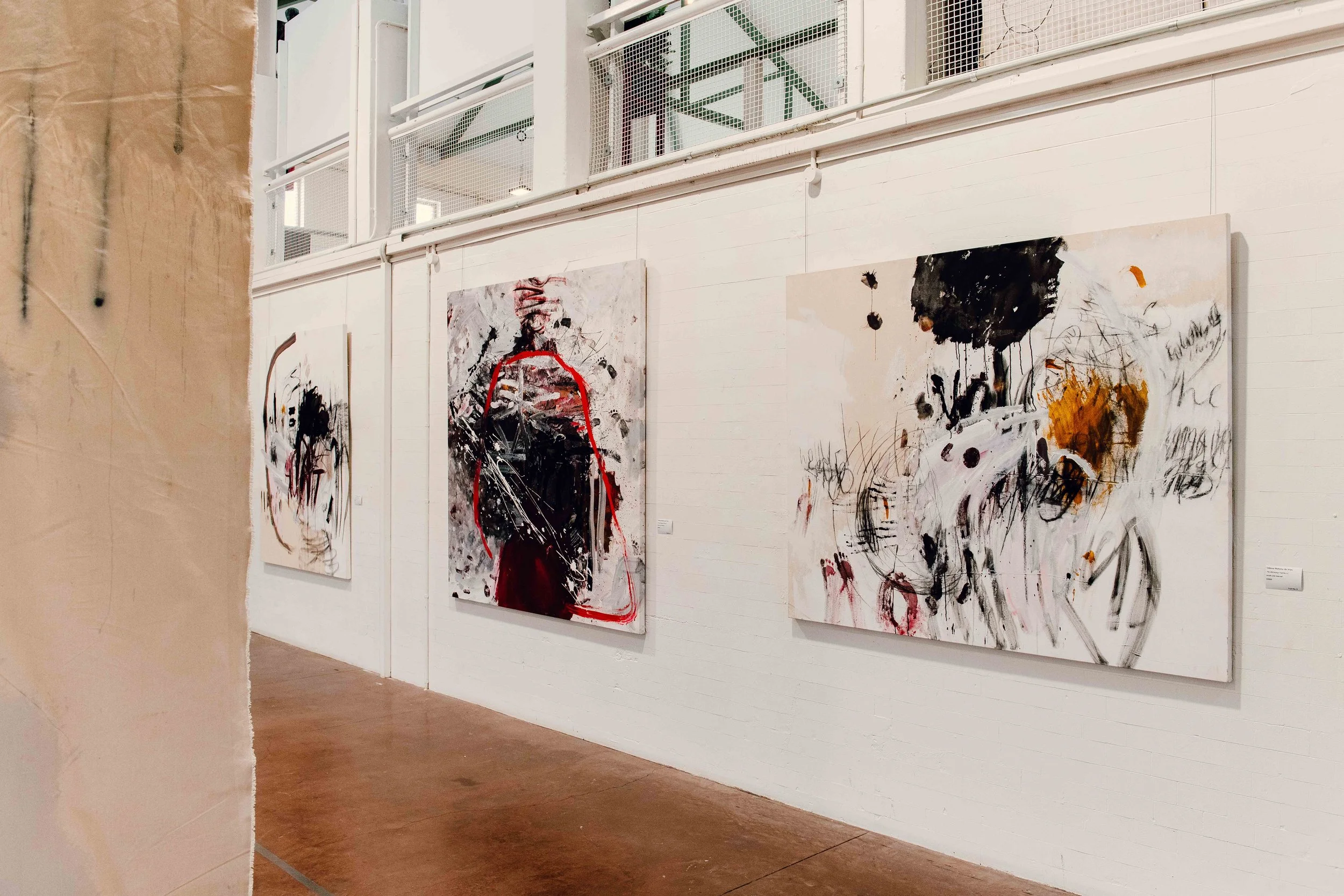
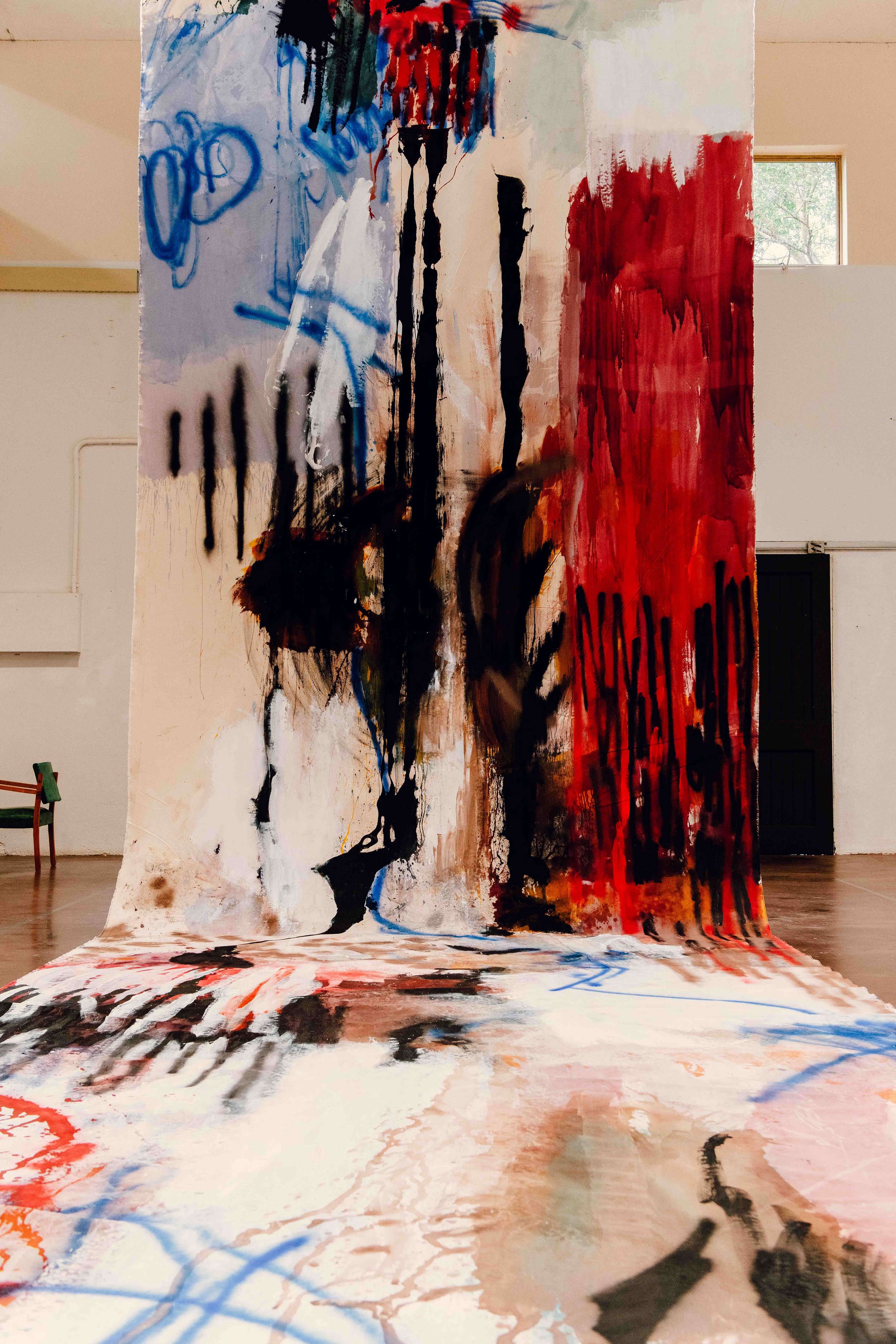
Odessa Mahony-de Vries’ Trial No. 8 is a sprawling, subversive body of work that deals with the aftermath of containment. Trial No. 8 is a series of experiments into the potentiality of constraints and interrogates, at the intersection of traditional painting and sculptural forms, the dialogical exchange between being bound and unbound. This unapologetic, obnoxious, lavish, and raw exhibition is driven by extremes. The exhibition features a series of paintings created at The Old Lock Up (Maroochydore, Kabi Kabi Country) where, in response to site, Odessa locked herself up in isolation in a 2.4m x 1.2m holding cell for 8 hours with 8 materials and 4 instructions to guide the creation process. Historically, 8 hours was the maximum length of time a person could be held at the jail before a firm course of action had to be taken - to be confined and charged under arrest or allowed to walk free. In stark contrast to this exercise in limitation, Odessa’s Instructions Unclear is an unrestrained 20m x 3.4m, 40 kilo canvas free-hung from the centre of the Butter Factory Arts Centre’s Butterbox. The work was laboriously and performatively created using scaffolding on the public facade of her home with an abundance of materials, space, and external influence. Alongside these works are a series of two-dimensional works that translate these creation processes as flattened mediatised images in both video and print.
Odessa Mahony-de Vries’ Trial No. 8 excavates the relationship between materiality and agency. Through a process of experimentation, trial and error, Odessa’s creative process is characterised by haptic explorations of materiality, immateriality, and methodologies relating to states of emergence. Physical matter is embraced as time-based phenomenon constantly in states of flux, transmuting, transforming, and each material offering emergent patterns. In the creation of Instructions Unclear paints were applied, smeared, spilled, mopped, and flung across canvas. The impetus behind the mark making belong to Odessa and each work’s compositional resolution is also determined by the hand of the artist. However, Odessa allows for phenomena such as gravity, time, wind, and the working space’s surface (or lack thereof) to influence the formal aspects of mark-making as collaborative influence. By decentering the hand of the artist, the behavioural tendencies of the materials are amplified, allowed to take course, propose alternative tangents, and carve the direction of the work. During the creative process of Instructions Unclear, Odessa was positioned atop construction scaffolding where paint was emptied out onto a vast stretch of unbound canvas below. Whilst very much remaining the inciting incident, the artist’s orientation was not the dominant, determinant influence. Chance and terrain become tools. Under the duress of repeatedly surrendering to the fall of the paint over the course of a 20m long piece and across 4 ½ days, the artist relinquishes jurisdiction over the work in favour of a mutual conversation between body and matter. Materials become active in determining their own statehood. As a consequence, the artist facilitates a process in which the materiality of form is not bound to precedent.
Amongst the brown, red, ochre, teal, black, pale green, and white deluges of paint, an electric azule aerosol line trails through Instructions Unclear as a galvanising counterpoint. Its erratic trajectory guides the eye down the L-shaped rigging of the canvas and along its length on the factory floor. In large part, the strength of the aerosol’s compositional framing is due to both its materiality and its interaction with the immaterial. Gravity - the fall, the drop, the spill - plays a pronounced role in the compositional logic of Instructions Unclear. So much so, that the air-carried azule line adopts an almost defiant gait in its juxtaposition. Whilst the majority of the mark-making is shaped by the downward influence of gravity, the directionality of the aerosol line houses a sense of horizontality and dispersal. This line cracks open the logic of the work. Givens surrounding the potential of both absorbency and accumulation are subverted and traditional conceptions of paint as a two dimensional entity are released to permit its three dimensionality to offer new logics within the work. Odessa redirects the authoritarian impulse within the artist towards facilitation and, by allowing space for the materials to exert their own influence, an agency is imparted.
This agency stems from the methodologies that Odessa employs to embolden the animate, unstable, transformative nature of her materials. Enlisting processes that confuse the territory between the animate and inanimate, Odessa works materials as malleable forms and sculpts them based on the emergent revelations each material offers over time. Formal limitations are resisted and provoked so that new possibilities can surface. Performing a similar role to the maximum holding time of 8hrs at The Old Lock Up, Odessa adopts the role of the container in which she sets constructs for encounters to arise within and then makes a decisive judgement on an action that will lead to compositional resolution - further formal confinement or a re-writing of the materials’ offer. Within this process lies a dialogue about concepts of regeneration and atrophy and, whilst peripheral to the artist’s stated aims, reflect larger conversations around incarceration’s capacity for contribution to meaningful reform. Foregrounded in Trial No. 8’s first piece, the video work depicts a pooling of black ink which, as both form and dimensionality appear, leads to the setting of a shape. Then through the confluence of time, gravity and immaterial influences, this mark and the architecture it adopts from pooling is overridden by more flow- thus a new indexical mark of these encounters is formed. In this way, the materials become wilful actors and agents within the artistic process and phenomenon often intangible to the gallery witness is made present through implication. In the temporal gap between the impetus of the mark and its resolution an event transpires. Through this time-based practice, Odessa uses layering as a way of destabilising both temporal and spatial points of origin. Composition is untethered from linearity. Concealment proposes absence making as an extended practice of mark making.
Odessa’s unwavering fidelity to non-representative forms is also counterintuitively extended to the non-exclusion of anthropocentric forms evoked from an engagement with site. According to the artist, the revelation of 1.1’s composition only became apparent in its hang. 1.0, 1.1, 1.2 were three paintings created simultaneously in The Old Lock Up. Two of the canvases were cut to the dimensions of the cell walls, the other to the dimensions of the floor, and then affixed to these working surfaces. Whilst completely masked to the artist’s eye as it was painted on the floor, the undeniable allusion to a figure in 1.1 became apparent only after being sent away to be hung and stretched. A sense of the aftermath, sweeps of violence, and threat loom in the work echoing the histories that reside in the site of its creation. Whilst the figurative is not a concern of the artist and often actively resisted in her work, its emergence was indisputable and to resist from a place of pure aestheticism, according to Odessa, would be to undertake an act of deception.“I am not interested in the lie”. Site-specific or site-responsive seems like misleading language- rather than including the influence of site into the work, it’s more accurate to say Odessa doesn’t obstruct its influence. The artist binds herself to comply with the four instructions as paramount to both process and form. By locking-in, the boundaries between artist, material, history, and site become porous and divisions of influence undermined.
Odessa Mahony-de Vries Trial No. 8 employs self-determined constraints as counterintuitive pathways towards radical non-compliance and freedom. Both ricocheting against and in gentle adherence to durational, spatial, and material limitations, Odessa’s Trial No. 8 pursues encounter as a central organising principle in both process and form. Bucking authoritarianism within the role of the artist in favour of facilitation enables the temperament of the materials and the alchemy of their relationship with the immaterial to emerge. Through an enforcement of strict methodology, Odessa performs the role of container and in doing so emboldens a dynamic for the materials to animate and exert agency. Trial No. 8 is both a subversion of autocratic systems whilst also an inquiry into restriction as a pathway to transformation.